The Purpose of Giving: What the Latest Giving USA Report Means for Fundraisers
By Rachel Stanley & Tiffany Reed
August 14, 2026
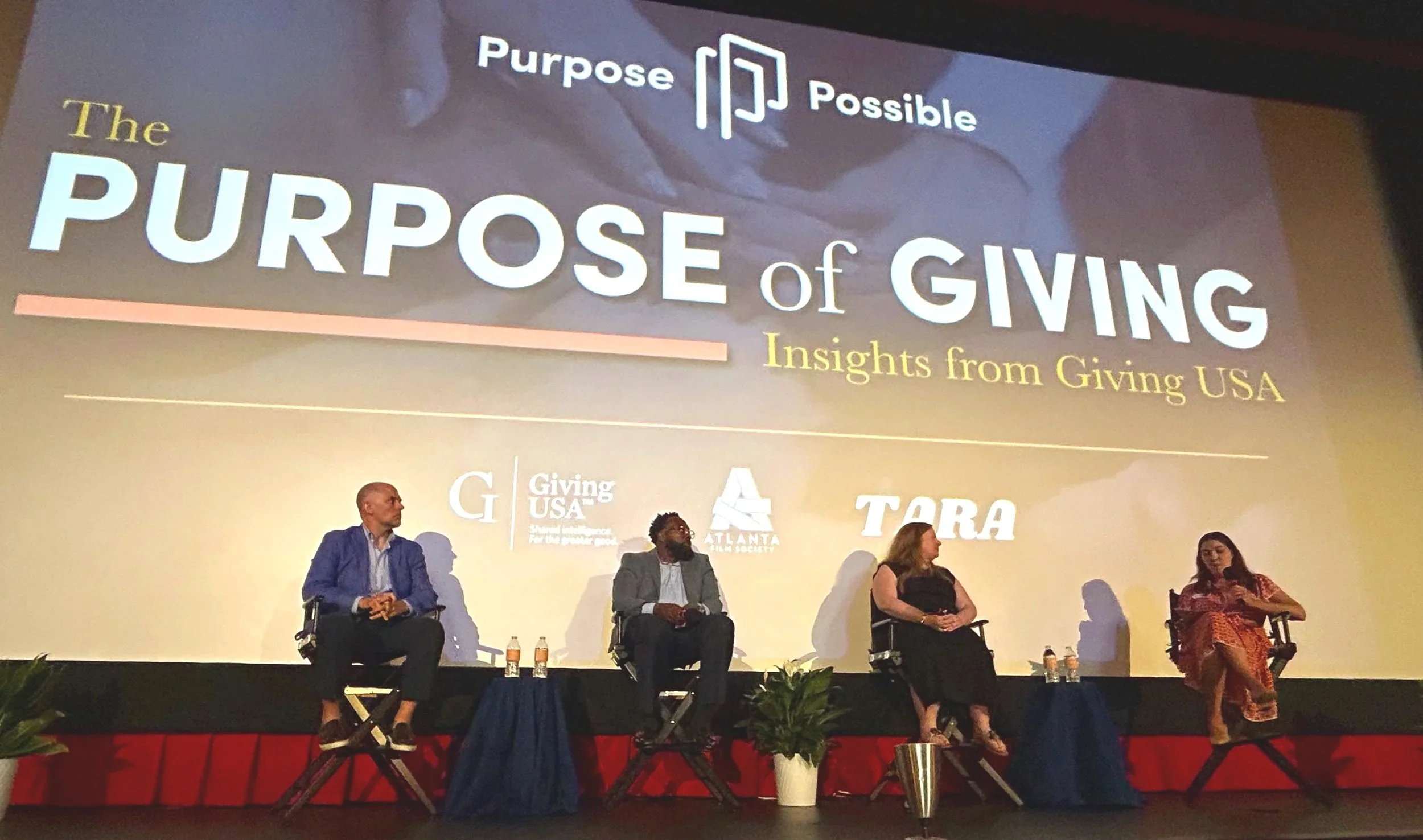
On August 12, 2026, we gathered with nearly 200 of our nonprofit and philanthropic colleagues at the Tara Theater for The Purpose of Giving: Insights from Giving USA, a presentation and panel discussion on the latest insights from the 2026 Giving USA Annual Report on Philanthropy—the longest-running report on American philanthropy.
The release of Giving USA each year opens debate among nonprofit staff and boards—where should we focus our efforts? Do these national trends match our reality?
Figuring out what the Giving USA research means for your development efforts is key.
Laura Hennighausen, Director of Strategic Philanthropy at Purpose Possible, walked us through this year’s numbers. Susannah Darrow, CEO and Founding Partner at Purpose Possible, moderated a panel discussion about what these trends look like in practice with:
Tim Bresnahan, Vice President of Advancement & Philanthropic Services, Community Foundation for Greater Atlanta
Megan Denton, Director of Development, Ignatius House Jesuit Retreat Center
Jaz’ Vick, Managing Director of Development, OneGoal in Georgia
Here’s what we learned:
Donations Are Larger but From Fewer Donors
Charitable giving in the US reached $617.2 billion in 2025, surpassing $600 billion for the first time in history. This 5.7% increase from 2024 to 2025 saw giving from individuals, foundations, corporations, and bequests all increasing. Bequests saw the largest increase, at about 20%, while corporate giving grew the least.
While charitable giving grew as a whole, we saw fewer individual donors. More giving is coming from a smaller number of people making larger gifts, the mega donor.
The pie is bigger. Your slice is smaller.
Individuals are still, by far, the largest source of charitable giving. But the ways people give are changing.
Donor-advised funds (DAFs), bequests, non-cash gifts, and qualified charitable distributions (QCDs) are all increasingly important—even as the number of 501c3 nonprofits keeps growing, meaning more organizations are competing for those dollars.
Where Donations Are Going
Religion remains the single largest recipient category, at 23% of total giving. Though giving to religious nonprofits has decreased dramatically from where it was decades ago, the religious sector remains the largest share of the giving pie. Religious institutions have built strong cultures of philanthropy in generation after generation, highlighting development best practices of asking widely and often. After religion, human services and education were the next highest sectors, though almost all sectors grew.
Donor-advised funds (DAF) add a wrinkle here: a DAF gift is categorized under whatever type of organization holds the fund. A gift to a community foundation falls under the foundation sector; gifts to national DAF fund holders fall under public-society benefit; gifts to issue-specific DAFs (such as to environmental or educational organizations) fall under those individual issue areas.
It’s Not Just How Much. It’s How.
Continuing trends from recent years, more and more donors are giving non-cash assets.
Bequests: Three of the last four years have seen 20% or more growth in bequest giving, speaking to rising estate values and long-term relationship cultivation by fundraisers at nonprofits.
Donor-Advised Funds (DAFs):
Over half of DAF donors expanded the causes they gave to in 2025.
The average DAF holds about $1 million, though that figure is skewed by outliers—most individual DAF gifts are under $1,000, and only 2% of DAF gifts exceeded $25,000.
Qualified Charitable Distributions (QCDs): With tax changes from the One Big Beautiful Bill (OBBB) taking effect in 2026, non-cash giving, particularly QCDs from Individual Retirement Accounts (IRAs), is becoming increasingly utilized, especially by more senior donors.
Now is the time to start or improve your organization’s planned giving program. The significant rise in bequests, arguably signaling the start of the Great Wealth Transfer, when trillions of dollars will be passed from Baby Boomers to their heirs–does not mean your organization needs to have a large development staff to accept planned gifts. It does mean making sure donors know these options exist. A blurb in a year-end email or annual report, stewarding your volunteers as potential donors, or simply raising the topic in conversation can go a long way.
Trust Matters When Money Feels Uncertain
Many Americans have been feeling uneasy about the economy and expect it to get worse, but they gave anyway. This makes the donor experience especially important. A thoughtful thank-you, an accurate tax receipt, or an update on a project all strengthen a relationship.
Recent tax law changes have also shrunk the pool of itemizers to primarily homeowners and wealthy individuals. New corporate regulations in OBBB have decreased incentives for corporations to give, creating a floor of 1% and a ceiling of 10% for tax-deductible corporate donations.
Despite these challenges, nonprofits are trusted institutions, trusted by more Americans than many political institutions. The challenge is that many Americans don’t understand or recognize nonprofits. Many people don’t realize that nonprofits impact many aspects of their lives: schools and after-school programs, parks and clean air, farmers' markets, animal shelters, advocacy organizations, and more. This is a clear growth opportunity for nonprofits to ensure your community knows that you are a nonprofit, are doing good work, and need donations.
Key Takeaways
Stop measuring success by how many people you reach.Measure it by how few you'd lose if the economy got worse.
Bequests, DAFs, and non-cash gifts aren't "someday" tools for a major gifts department; all nonprofits should solicit them.
You already have more trust than you think but people don't always recognize a nonprofit when they see one.
Don't wait for donor confidence to feel high before you ask.
What should fundraisers focus on before year-end?
As we look to the fall, fundraisers can capitalize on Giving USA’s research with the following practical tips:
Know your donors: Clean data makes it much easier to understand donor behavior, honor preferences, and decide where a small development team should spend its time. Make time to update and clean your donor database.
Prioritize stewardship: With fewer donors accounting for more giving, retaining relationships matters. Before year-end, look at who needs a thank-you, an update, or a more personal touch.
Make giving options visible: DAFs, QCDs, bequests, securities, and other non-cash gifts don't have to have a dedicated staff member to shepherd them. A mention in a year-end email, annual report, or donor conversation can be a start. Also consider using third-party tools to help with the acceptance and administration of donations.
Keep asking: We may not be asking often enough, for enough, or in enough ways. Don't assume a donor's previous gift is the limit of what they're willing to give. Many donors give several times throughout the year.
Audit your relationship-building: Take a look at your donor stewardship and cultivation efforts. What materials or processes need a refresh? What can you replicate or deepen rather than simply adding more to the development team's to-do list? Auditing your efforts helps clarify where lean teams in particular should spend their time.
Trends are only useful once you've figured out what they mean for your organization. If you're sitting with questions about where your donor pipeline stands, whether your team is set up to accept bequests and DAF gifts, or want a second set of eyes on your year-end plan, that's the kind of thing we spend our days on at Purpose Possible. Contact us or schedule a consulting session to work through this with a development professional.
Related Resources
Community Foundation for Greater Atlanta Resource Hub